Thursday, March 01, 2012

I came across this poem in my reading for my sermon this week. I really liked it.

When I Become A Christian ~ -Adrian Plass 


When I became a Christian I said, Lord, now fill me in,
Tell me what I’ll suffer in this world of shame and sin.
He said, your body may be killed, and left to rot and stink,
Do you still want to follow me? I said Amen - I think.
I think Amen, Amen I think, I think I say Amen,
I’m not completely sure, can you just run through that again?
You say my body may be killed and left to rot and stink,
Well, yes, that sounds terrific, Lord, I say Amen - I think.
But, Lord, there must be other ways to follow you, I said,
I really would prefer to end up dying in my bed.
Well, yes, he said, you could put up with the sneers and scorn and spit,
Do you still want to follow me? I said Amen - a bit.
A bit Amen, Amen a bit, a bit I say Amen,
I’m not entirely sure, can we just run through that again?
You say I could put up with sneers and also scorn and spit,
Well, yes, I’ve made my mind up, and I say, Amen - a bit.
Well I sat back and thought a while, then tried a different ploy,
Now, Lord, I said, the Good book says that Christians live in joy.
That’s true he said, you need the joy to bear the pain and sorrow,
So do you want to follow me, I said, Amen - tomorrow.
Tomorrow, Lord, I’ll say it then, that’s when I’ll say Amen,
I need to get it clear, can I just run through that again?
You say that I will need to joy, to bear the pain and sorrow,
Well, yes, I think I’ve got it straight, I’ll say Amen - tomorrow.
He said, Look, I’m not asking you to spend an hour with me
A quick salvation sandwich and a cup of sanctity,
The cost is you, not half of you, but every single bit,
Now tell me, will you follow me? I said Amen - I quit.
I’m very sorry Lord I said, I’d like to follow you,
But I don’t think religion is a manly thing to do.
He said forget religion then, and think about my Son,
And tell me if you’re man enough to do what he has done.
Are you man enough to see the need, and man enough to go,
Man enough to care for those whom no one wants to know,
Man enough to say the thing that people hate to hear,
To battle through Gethsemane in loneliness and fear.
And listen! Are you man enough to stand it at the end,
The moment of betrayal by the kisses of a friend,
Are you man enough to hold your tongue, and man enough to cry?
When nails break your body-are you man enough to die?
Man enough to take the pain, and wear it like a crown,
Man enough to love the world and turn it upside down,
Are you man enough to follow me, I ask you once again?
I said, Oh Lord, I’m frightened, but I also said Amen.
Amen, Amen, Amen, Amen; Amen, Amen, Amen,
I said, Oh Lord, I’m frightened, but I also said, Amen.

Friday, December 16, 2011


Friday, December 16, 2011

I am poor and needy, but the Lord takes thought for me. ~ Psalm 20:17

As Servants of God we have commended ourselves in every way: as poor, yet making many rich; as having nothing, and yet possessing everything. ~ 2 Corinthians 6: 4,10

Prayer: Enduring God, help us see past material possessions and wealth here on earth to center ourselves on serving you all the days of our lives. Even if we have nothing, we have all in you. Amen.

Thoughts: Today begins an experiment in trying to blog my thoughts and prayers of the Moravian Daily Text.

I laughed when I read the passage from Corinthians today, as we are truly in the middle of the Christmas shopping season. Our possessions, or often lack there of, can really be what defines us. And when it comes down to it, I know that I have more than I need. I have more food and clothes than I need. And past that, I have way more than what one really needs to live. Yet, even though I am not really poor in the worldly sense, I often feel rich/wealthy in the spiritual sense. And even though I feel that wealth, I am still shocked when others share that I help them feel rich in spiritual ways. It shocks me that I am able to do that, and it is my prayer that I continue to be able to do that as I serve others, who are often rich in possessions but poor in faith.

Tuesday, March 22, 2011

If Darwin Prayed

Every so often, one stumbles across a new phrase which one didn't know, but upon reading and understanding it, immediately understands something you've believed all along. The phrase "evolutionary faith" is one which is going to make a major impact in coming years. As the emergent faith movement moves out of its infancy, and conservative faith realizes that its "young earth" theology is downright ridiculous, Christians of all sorts will begin to realize that deep faith is one which grows alongside other disciplines (such as science and technology) and does not see them as a threat to faith, but something which helps faith grow.

This book is a wonderful collection of a pastor's evolving prayers, which invokes his growing faith in Christ as one who calls us to grow and follow.

Check this book out if you like well written, thought(ful) provoking prayers.

http://ifdarwinprayed.com/

Monday, August 02, 2010

Sacred Unions, Sacred Passions: Book Review


Growing up, I heard that Eskimo’s have over 100 different words for “snow”. That when your life is surrounded by snow, your language will reflect the subtle differences in the cold precipitation. It was somewhat comforting to think that at least one group of people could adequately describe something so central to their life.


Now that I am older, I know that this story I heard as a child is a myth. No group of people have 100 words for snow. But if there was one concept in life which is deserving of such an honour, it is love.


In his book, Sacred Union, Sacred Passions, Dan Brennan writes about how through the history of humanity, love has come to take on many forms. One of the least accepted forms in society is the male-female, non-sexual, relationship. This book highlights this under-developed, often misunderstood form of love in a world which desperately needs its strength.


As most “emergent” literature is today, this book takes aim at conservative Christianity, whose views of relationships and sexuality is behind the times. And while Brennan does a good job of keeping this to a minimum, while highlighting the numerous denominations who do a better job at male-female, non-sexual relationships, it is a good book to read if you are unsure as to what should be the role of people of the opposite gender in your life.


My only disappointment with this book is that it seemed to minimize the difficulties as well as the dangers of this type of friendship. In a modern world which focuses on the shallow view of human sexuality, we need direction on how to form these positive, Christ affirming relationships in such a way that sexual intercourse is not the desired outcome. (I hope this might be addressed and developed in a second book!)


Pick this book up... its worth it to help begin to change the world to have a more positive view of love, relationships and sexuality!

http://www.amazon.ca/Sacred-Unions-Passions-Engaging-Friendship/dp/0982580703/ref=sr_1_1?ie=UTF8&s=books&qid=1280731568&sr=8-1


Sunday, February 07, 2010

Feb 7, 2010

Does anyone want to take a guess of the age of the average life expectancy is in Canada? 80.4 years is the answer. And sometimes I think we take for granted that we have such a long time to live, especially when it comes to Christianity. When we hear stories like the one we hear today, I think we’ve been told to imagine either some older teens or those who are in their young 20’s for those that Jesus called to be his disciples. While that seems “young” by our standards today, this was not the case in Jesus’ time.

The day that I moved into my first apartment in Seminary, I was introduced to a man named Meza, who was living in the building. He was from Tanzania and I was asked help show him around town, and help answer any questions he had about living in America. I was glad to help, as I was a former exchange student and knew what it was like moving into a new culture. This first introduction to Meza was something that was going to turn into a strong brotherhood. We would sit in each other’s apartments for hours while we were avoiding assignments, and allowed us to talk about all sorts of topics.

The name of the building we both lived in was called the Widow’s house, and was originally built in the mid 1700’s at the height of the Moravian choir system, where people lived according to their status in the community. The young men lived in the single brethren’s house, the singe women in the single sister’s house. The married couples lived together, and the widowed lived together in the Widow’s house. Widows had lived in that house for over 250 years. And the Moravian seminary had bought the building, but there was still 4 widow’s living there.
I remember that we celebrated the birthday of one of the widow’s one day, and after the celebration, I went back to Meza’s room to chat. Meza was amazed that this particular woman was celebrating her 90th birthday. Stuff like that just doesn’t happen often in Tanzania.

Naturally I asked my friend what the average life expectancy was in his country. He guessed that the average person in his home country lived to the ripe old age of 45. While this gave me a bit of a shock, what truly gave me shivers is that my friend was already in his mid 30’s. It struck me as very odd that Meza at 35 had already lived a great portion of his life.

Thankfully as I was doing research for this sermon, I looked up this info and found out that the average life expectancy in Tanzania was in fact 55, which gave me a huge sigh or relief, but it also showed that at the time of his birth, the age was 45. In nearly 4 decades now, with modern medicines and technology finally making its way to the middle of Africa, the life of the average person has extended 10 years.

I tried to look up this same statistic concerning Jesus’ time, and I found a wide variety of answers. While no one can be sure what the average life expectancy was in Jesus’ time, I think we can safely guess that it was in the mid 30’s. And when we combine that with the thought that most scholars believe Jesus to have began his ministry around the age of 30,
Even though we might be tempted to view Jesus and these first disciples as being on the younger side of things, we need to realize that they were, at the age of 17, already done with half of their lives.

I tell you all of this because it is my hope that you would be able to identify with the calling of these first disciples. Here they are, at the end of a long day of work with nothing to show for it. They’ve thrown out their nets a hundred times. And found little success. So they came into shore, and began to clean their nets. All those attempts must have meant they caught a lot of seaweed. So in comes Jesus, noticing a bunch of folks along the shore, he decides to use one of the fisherman’s boats to preach from. So these fishermen get to listen to the word of God as they finish their day. No one knows if Jesus finished preaching or if the fishermen wanted their boat back, but at this point, Peter and Jesus begin to interact. He challenges Peter and his comrades to go back out into the water.

At first, Peter complains. I love this part, because it fits in with my personality so well. I am inherently lazy. I don’t want to do more work at the end of an unproductive day. I’d rather just go do something else. Relax with friends, go watch a movie…something other than what I’ve been doing all day.

So Peter and his buddies go back out. Going back out means a couple things... First, it means having faith in what Jesus says. We all know about this. Having Faith in Jesus is nothing new. What’s infinitely more important is that after we have faith in Jesus, after a long day of fruitless labor, that we go out and follow what Jesus wants for us, we’re suddenly knee deep in fish, which means we’re knee deep in work. They have so much work to do that they have to call others over to help them.

Once they got back, their work wasn’t finished. Most of the markets for the day would probably be closed, and they would have had to finish salting their catch late into the night. There was a lot of extra’s that came from following Jesus command.

Now we have Peter and crew coming in from a catch so large that his boat was sinking as it came in. When it says that Peter fell to his knee’s, we might be able to imagine that Peter landed on his catch. And as he did so, he said “Go away from me!”

But Get away from me is a poor translation of the Greek. A better translation of Peter is “Get out of my neighborhood!” Peter realized that Jesus was going to have them doing a lot more than they were used to doing. And his initial reaction was to make Jesus leave so it wouldn’t be his problem.

Jesus then answers… “Don’t be afraid”. With that answer, Jesus realizes that Peter is scared of the possibilities Jesus offers. There is a common thought that people are afraid of change. This is far from true. The world changes all the time. We are not afraid of change, we are afraid of loss! The loss that they were afraid of is the loss of what they knew. One of the reasons I am always afraid of change is because it will mean that I can no longer be as lazy as I’d like to be. Following Jesus means a loss of who we are and what we are used to. Even though Jesus is telling us not to be afraid, surely we will be afraid with the changes that will happen when Jesus calls us to catch people.

This church has been fishing for a long while, and rarely have we caught enough fish to feed ourselves. We are at the stage where we are listening to Jesus on the shore, cleaning our nets. And I truly believe that sometime in the near future, Jesus is going to call us to go out can cast our nets again and we are going to be surprised with what we come up with. Jesus is going to give us a lot of work to do when we catch for him. Until then, we must work on our nets. The things essential to who we are. We need to find ways to strengthen our prayer life. We must be hospitable and generous enough to let Christ use our boats, and we must listen at the foot of Christ, listening to the word of God.

Join me in prayer:
Loving God, you have come to us in your Son Jesus Christ, you have given us your Holy Scripture as that which we are to listen to as we go about our daily tasks. We know that in the future, you will ask us to cast out our nets among the people. We pray that when the time comes, you will find us willing to follow you. Until that time comes, we sit at your feet and will listen with open ears to that which you would have us hear. Amen

Wednesday, September 30, 2009

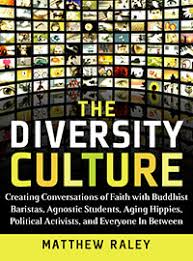
The Diversity Culture Book Review


The book written by Matthew Raley entitled The Diversity Culture: Creating Conversations of Faith with Buddhist Baristas, Agnostic Students, Aging Hippies, Political Activists, and Everyone in Between is certainly one which seems to have a lot of expectations just from the title. Yet Raley’s book does not cover any of these specific groups, but wonderfully groups them under the umbrella of the “Diversity Culture”.

Written by a person who does not feel at home in any particular category, but would perhaps best identify with conservative evangelicals, he does a fantastic job of pointing out where they have failed in this new individually tailored culture.

In the past, the evangelical community has attempted to reach out to the people they do not quite understand by using marketing systems which were popular a decade or more ago (us church folks are always a bit behind the curve). Instead of calling for us to catch up with the curve, Raley dares us to disregard the curve altogether and replace it with Jesus’ model which comes from the Gospel of John, chapter 4 where Jesus encounters the Samaritan woman at the well.

Instead of using outdated marketing strategies which people in the Diversity Culture will smell a mile away, Raley points out three different kinds of confrontations which he feels Jesus used, which go from subtle to blunt. First is to give a new point of view. Second is to decline to agree with excuses. Third is to define options. All of these options are ones which Jesus employed with the woman at the well, which led to her declaring that Jesus is the Christ.

This is not a book for someone looking for a quick answer to convert someone who does not believe in the same things you do, although the sub title might seem to imply it. Using Jesus as a model for conversion is not an easy task, but reading this book will help give you the confidence and biblical background necessary to take on the hard job ahead.

Thursday, June 04, 2009

Pentecost Sermon

Today is an exciting day in the Christian calendar… so exciting that most of you are wearing the colour red as a reminder of what day it is. Today we celebrate Pentecost. 50 days after the resurrection of our Lord and Savior. 10 days after his ascension into heave. Today is the day we celebrate the coming of the Holy Spirit, the day the 12 apostles received the gift of tongues, the day which some argue as the first day Christianity became an actual religion. It is a day we celebrate the completion of the Trinity. Truly this is an important day for us to remember.

Now, for those of you who do not know, I have just recently graduated from Moravian Theological Seminary. I have spent the last 3 years studying scripture, learning how to preach and teach and look at things from a theological perspective. Most of the time, this ought to give me an advantage in understanding the Scripture, but in this instance, I’m not sure if it really does. You see, it seems that for those who are theologically trained, it is easier for us to identify with the 12 disciples who had tongues of fire come and rest on them. That’s the reason we pastors ask you to wear red on days like this. We want you to identify with the disciples like we do.

Unfortunately I don’t think most people identify with the 12. I don’t think we really grasp the concept of speaking in tongues…otherwise we probably wouldn’t be in the Moravian church this morning, we would be in a Pentecostal church, watching others around us speaking in tongues. The question then becomes who do we identify with? How does the story of Pentecost become the story of us?

I think we best identify with the crowd…the ones who gathered in bewilderment at the strange sound that apparently emanated from those flaming tongues. Perhaps we even are a part of the crowds who proclaimed that the disciples have had too much wine. We are the ones who listened to Peter, the rock on which Jesus shall build the church, who heard the words

“People of Judea and all who live in Jerusalem, let this be known to you, and listen to what I say. 15Indeed, these are not drunk, as you suppose, for it is only nine o’clock in the morning. 16No, this is what was spoken through the prophet Joel: 17‘In the last days it will be, God declares, that I will pour out my Spirit upon all flesh, and your sons and your daughters shall prophesy, and your young men shall see visions, and your old men shall dream dreams. 18Even upon my slaves, both men and women, in those days I will pour out my Spirit; and they shall prophesy. 19And I will show marvelous things in the heaven above and signs on the earth below, blood, and fire, and smoky mist. 20The sun shall be turned to darkness and the moon to blood, before the coming of the Lord’s great and glorious day. 21Then everyone who calls on the name of the Lord shall be saved.’

That everyone that Peter and Joel were referring to is you and I. Now, the Scripture which we read today ends without telling us what happens to the crowd. In fact, most of the Book of Acts focuses more on what happened to the apostles rather than the regular people. Its only natural for a story to focus on the people who received those flaming tongues… but it means we are stuck as congregations knowing how to function. Now over the past 2000 or so years, we’ve developed complex systems of how we “do” church. We have pages and pages of bylaws, we have unwritten rules of what it means to be a member of each and every one of our congregations… yet often we fail to look at the end of the second chapter of the book of Acts to use as a guide in how to do church.

Verses 42 through 47 state that “they devoted themselves to the apostles’ teaching and to the fellowship, to the breaking of bread and to prayer. Everyone was filled with awe, and many wonders and miraculous sings were done by the apostles. All the believers were together and had everything in common. Selling their possessions and good, they gave to anyone as they had need. Every day they continued to meet together in the temple courts. They broke bread in their homes and ate together with glad and sincere hearts, praising God and enjoying the favor of all the people. And the Lord added to their number daily those who were being saved.”

Now, there is a growing movement in Christianity today to get back to this type of church. The idea of communal living and helping their neighbors in a sort of new monastic movement has really caught on. In fact, next fall Moravian seminary is going to have a special guest lecture by Shane Claiborne, a person who is leading an intentional community of believers who seek to make a difference in Kensington Philadelphia. Yet, as appealing as this idea might be to some, I don’t think the answer to identifying with the first century church is to act in the same manner as much as possible. Instead the answer lies in the gospel text we heard this morning.

From John 16:13 we hear that “When the Spirit of truth comes, he will guide you into all the truth; for he will not speak on his own, but will speak whatever he hears, and he will declare to you the things that are to come.”

This means that the answer to being a successful church, the answer to the question of how we identify with the crowd of believers at the very first Pentecost is to be led by the Holy Spirit. To be led into the truth. This should be both an exciting and scary journey. To be led by the Spirit means that we must be willing to go to places we never thought we would go before. Remember how I had previously said that when we pastors ask you to wear red, its usually because we want you to identify with the disciples? When you look at the red that you are wearing, you should instead identify with being led by the spirit as a community of believers.

There are really only two keys which I believe the early church gives us as a model to being led by the Spirit today. The first is the breaking of bread and the second is prayer. Take a moment to look at the family on your right and on your left. When was the last time you broke bread with them and prayed with them in a place other than church? When was the last time that together you sought to help their neighbors who had a particular need? Our challenge is to get to know one another as brothers and sisters in Christ so that we may share what we have with those who need it. I don’t know what the needs of those around you are. The only way we find out is through time together and prayer and then a willingness to follow the Spirit’s answer.

I trust that the Spirit is going to lead this congregation to do amazing things in the west side of Bethlehem. The only thing we have to do is follow.

Tuesday, May 12, 2009

Book Review


I have recently joined a website which allows me to read books on Christianity with a postmodern twist for free, with the catch that within 30 days of receiving the book, I must write a 50+ word review of it. 

The first book I received was Spirituality by Carl McColman and the following is the review I wrote.

The idea that more and more people are open to spirituality which does not come directly from the Christian church seems to be the purpose behind the 10 year reprint of Carl McColman’s book Spirituality: A Postmodern and Interfaith Approach to Cultivating a Relationship with God.

As I began reading, I must say that I found the introduction as well as the first three chapters to be rather circular. Instead of saying anything with deep interest, McColman would dance around topics like Breathing, Tillage, and Wonder by providing the etymology (the study of the origins of a word) in order to broaden the readers definition. This is helpful, but too often I found the author talking about all the different sides and angles which spirituality can take, which leads me to wonder if there is a proper path in seeking spirituality. I would guess that McColman believes any path of spirituality is a positive one.

The most interesting parts of the book are when the author writes out of his personal experience. Unfortunately these stories are too few and lead me to wonder if his spiritual experiences connect in any particular way, or if they are simply a string of experiences which lead him to act in new ways.  Instead of allowing the reader to drink deeply of his own spiritual journey, we are stuck with snippets of a journey which is probably much more interesting than said or has not been reflected upon long enough to be of meaning to others.

As McColman has written other books in the “An Idiots Guide” series, I am left feeling that a better title would have been “An Idiots Guide to Spirituality”. For that is truly what this book is. The subtitle is misleading, as postmodern and interfaith are mere buzz words to catch a particular audience. Purchase this book only if you feel your knowledge of the spiritual is very low or very narrow.


Sunday, April 12, 2009

An Easter Meditation

Love wins.

Say it with me…

“Love wins!”

We are about to go outside to watch the sun rise on this Easter morning. This is not a victory of good over evil, or life over sin. When we go outside and feel the sun on our face this morning, we are witness to the fact that love wins.

I’m going to read some short passages of scripture and when I prompt you, I’m going to ask that we end each reading with the phrase; LOVE WINS.

Matthew 5:43-44

             "You have heard that it was said, "You shall love your neighbor and hate your enemy.' But Jesus says to us, Love our enemies and pray for those who persecute us.” From this we know: LOVE WINS

Matthew 22:36-39

            Someone asked: "Teacher, which commandment in the law is the greatest?"  Jesus said to him, " "You shall love the Lord your God with all your heart, and with all your soul, and with all your mind.' This is the greatest and first commandment. And a second is like it: "You shall love your neighbor as yourself.' From these commandments, we know that: “LOVE WINS”

John 13:35

            By this everyone will know that you are my disciples, if you have love for one another." This morning we declare that: LOVE WINS

John 15:9-17

 As the Father has loved me, so I have loved you; abide in my love.  If you keep my commandments, you will abide in my love, just as I have kept my Father's commandments and abide in his love.  I have said these things to you so that my joy may be in you, and that your joy may be complete.  "This is my commandment, that you love one another as I have loved you.  No one has greater love than this, to lay down one's life for one's friends.  You are my friends if you do what I command you.  I do not call you servants any longer, because the servant does not know what the master is doing; but I have called you friends, because I have made known to you everything that I have heard from my Father. You did not choose me but I chose you. And I appointed you to go and bear fruit, fruit that will last, so that the Father will give you whatever you ask him in my name. I am giving you these commands so that you may love one another. We are your friends and will continue to abide in the fact that: LOVE WINS


Romans 5:8

            But God proves his love for us in that while we still were sinners Christ died for us. This morning as we celebrate Jesus’ resurrection, we are witness to the fact that: LOVE WINS


Romans 8:35-39

                What will separate us from the love of Christ? Will hardship, or distress, or persecution, or famine, or nakedness, or peril, or sword? As it is written, "For your sake we are being killed all day long; we are accounted as sheep to be slaughtered."  No, in all these things we are more than conquerors through him who loved us.  For I am convinced that neither death, nor life, nor angels, nor rulers, nor things present, nor things to come, nor powers,  nor height, nor depth, nor anything else in all creation, will be able to separate us from the love of God in Christ Jesus our Lord. Even though these things will try to separate us from Christ’s love, we know that: LOVE WINS

1st Corinthians 13

             If I speak in the tongues of mortals and of angels, but do not have love, I am a noisy gong or a clanging cymbal.  And if I have prophetic powers, and understand all mysteries and all knowledge, and if I have all faith, so as to remove mountains, but do not have love, I am nothing.  If I give away all my possessions, and if I hand over my body so that I may boast,  but do not have love, I gain nothing.

 Love is patient; love is kind; love is not envious or boastful or arrogant  or rude. It does not insist on its own way; it is not irritable or resentful;  it does not rejoice in wrongdoing, but rejoices in the truth.  It bears all things, believes all things, hopes all things, endures all things. Love never ends.

But as for prophecies, they will come to an end; as for tongues, they will cease; as for knowledge, it will come to an end.  For we know only in part, and we prophesy only in part;  but when the complete comes, the partial will come to an end. When I was a child, I spoke like a child, I thought like a child, I reasoned like a child; when I became an adult, I put an end to childish ways. For now we see in a mirror, dimly, but then we will see face to face. Now I know only in part; then I will know fully, even as I have been fully known. And now faith, hope, and love abide, these three; and the greatest of these is love.

Through the resurrection of Jesus Christ, we have seen face to face that: LOVE WINS

Let us now go outside to finish the Easter Morning Liturgy and proclaim with every fiber of our being that LOVE WINS.

Sunday, March 29, 2009

No Turning Back

          Have you all seen the latest Geico commercial? The one where the CEO of the company is chatting with the gecko mascot about how when people hear the name of the company, they associate it with the term “trust” and then he gets out from behind his desk and decides to try one of those “trust falls” where he expected the little gecko to catch him safely. The obvious joke is that a tiny lizard is incapable of catching a human being, no matter how much trust there is in their relationship.

            I really like this commercial, mainly because in my own life, I have a difficult time trusting others in activities like these. During my many years at Camp Hope, I participated in many of these trust falls… and being a heavier guy, when I knew this was going to take place, I always did my best to pair up with someone I knew who could catch me. The only way I could place my trust in being caught was if I first placed my trust in the fact that the catcher had the right amount of strength. I always picked the right partner to catch me, and thus never ended up falling on my backside.

            When I went to college, I ended up joining a fraternity, and part of being in my particular fraternity meant quite a lot of time being blindfolded as we awaited our fraternity rituals. I could never tell if the fraternity just had cheap blindfolds of if I had a really big nose, but there was always a slight gap between the blindfold and my face, allowing me to see a small amount of the ground in front of me. I remember just before the ritual which made us pledges in the fraternity, as I was being led in a blindfold, the brother stopped us and whispered into my ear: “Do you trust the brotherhood?” Of course I answered yes. Now, perhaps it was because I could see, even if it was the smallest of slivers, but I’m not sure what I would have said if I had been in complete darkness.

            I share these things with you because I think it makes sense to look at the second half of today’s lesson before we look at the first. Here we have Jesus talking about being the light and that the apostles would have the light with them for only a little while longer. This isn’t exactly a statement which the apostles want to hear. If you believe the Messiah is with you, the last thing you expect him to say is that he’s leaving. Then Jesus speaks these words which we find in verse 35 and 36… “You are going to have the light just a little while longer. Walk while you have the light, before darkness over takes you. The man who walks in the dark does not know where he is going. Put your trust in the light while you have it, so that you may become children of light.” (NIV)

            “Put your trust in the light while you have it.” Now that’s a statement which makes a lot of sense to me, given my own experiences, and I hope it does for you as well. We all know that it is easier to trust when we can see what’s going on and this reminder that Jesus gives comes directly after Jesus talks about the death of a seed. Now, obviously we understand the concept that a seed must “die” and be buried in order to grow and produce fruit. This is the essence of what it means to be a follower of Jesus. The light of the world is now telling his apostles that he is going to die in order to be glorified…and that those who will follow him will do likewise so that they too may glorify Jesus.

When Philip and Andrew go to speak with Jesus on behalf of their Greek friends, I’m not so sure they were expecting the reply they got. One scholar[1] calls this passage the point of no return for the apostles, and I’m just guessing here, but I think when the apostles heard what Jesus said, their throat tightened a bit and there was a knot in their stomach. They wanted to follow Jesus, but for the first time, they now realized their lives were on the line… they had crossed the point of no return.

This whole concept of crossing the point of no return is one which defines all of our lives and we have all had these moments. Maybe it was a moment of putting a large amount of your financial savings into a somewhat risky investment. Maybe it was taking a new job. Maybe it was when you said your wedding vows… It’s similar to riding a roller coaster… Initially you strap yourself in and then the coaster begins to move up the big hill… as you slowly make your way to the top, there are these stairs along the side which might give you some thought that if you did something crazy enough, you could get the roller coaster to stop and then walk down those stairs to the safety of the ground below. The point of no return comes when you are no longer being pulled up to the top, but the first cart has made it over the top of the hill and you are no longer in control of your own destiny.

This roller coaster which Jesus and the apostles were riding has just come to the pinnacle of the tallest drop. Even Jesus points out that he is a bit nervous and yet is doing this completely for the glory of God. God even recognizes this fact and tells them that God has glorified it and will do so again.

The season of Lent is full of drama… we are descending in Holy Week, a time of defeat, destruction, and betrayal. It is by no means for the faint of heart. Just as roller coasters come with a warning for those with heart conditions, Lent should have a similar warning for the followers of Jesus. That warning reads: “Those who love their life will lose it, while those who hate their lives in this world will keep it for eternity.”

This is a scary warning and I must admit that, continuing with the roller coaster metaphor, I have not yet gotten on the ride. Yet, I feel as if I am standing in the line, watching others get ahead of me. I smile politely as I let others get in front of me. I’m not fully ready to give up my own life to God’s glory and I think God knows that about me right now. God knows where we each are standing in line. I think God knows that some of us might never take the ride and that’s ok. I think God is excited because God knows that soon some of us are going to strap ourselves in for the ride of our lifetime. It all gets back to the issue of trust, which is ultimately a means for reconciliation.  We get on that roller coaster because we long to take the same path which Jesus took.  We long to see him after our ride is completed. We long to see our loved ones who have already completed their trip. In the end, we long to go home to a God who is so glad that we took a risk and rode the scariest ride at the amusement park.


[1] "The Point of No Return," Rev. Bethany Hull Somers, Preacher's Magazine, 2009.

Monday, February 16, 2009

A poem.

This poem was given to me by two very good friends...

Old Clothes

Do you mind me approaching You in old clothes, Master?
They are so comfortable and easy.
Baggy where they need to be
they give when I move.
They are so much part of me that
I don't need to think about them.
New clothes make me self-conscious and so very careful about stains and creases.
When I go out in my new outfit
my thoughts revolve around myself.
How I look and feel,
how others think I look,
what impression I am giving. 
But when I'm in my old clothes my thoughts are free,
they fly in all directions
often winging their way to You, Lord.
So You won't mind if I don't dress up to talk to You?
It's no sign of disrespect
but rather of my belief in Your understanding
heart,
Your generous acceptance of me
Just As I Am
without frills or fancies.
Thank you, Lord, for that freedom.

Sunday, February 15, 2009

Grace... Its How We Live.

I don't know about you, but when I hear the word grace, the first thing which comes to mind is the short prayer my brother and I are asked to say prior to every meal when we eat as a family at home. My brother and I to this day still say the same grace we were taught as children, although my favourite one comes from the one time my grandfather was asked to say grace. If I remember correctly, it was "Through the lips, past the gums, watch out stomach, here it comes, yay God!" I later learned from him that it was the "yay God" part which made it an official prayer.


Other than meal times, the word grace isn't used all that often in our every day lives. Sometimes we use the words gracious, which can mean pleasantly kind, benevolent, and courteous, merciful or compassionate[1] and we usually reserve this word for someone who does something nice for us which we didn't expect. To be gracious, or to extend grace, really means to do something which the unexpecting person does not anticipate.


The only other time I can really remember hearing the word grace on a regular basis is in our communion liturgies where we hear the words "Grace, Mercy, and Peace, from God our Father and from our Lord Jesus Christ..." If you're anything like me, perhaps you have not really given much thought to the word grace and what it means to us as everyday followers of Jesus.


Of course, then again there's Amazing Grace, which is the theme for today and is the focal point of the message to be shared by the middle school students here in a bit. We're going to learn about John Newton, the author of the song we all know and love. Grace was something very real to him in a way which we may or may not understand. Not all of us have the same life and death situations in which grace is bestowed upon us in such a magnificent way. Not all of us go around the world as a part of our job stealing other human beings from their towns, live on a boat for long periods of time, subject to the waves of the sea. Not all of us make decisions which directly effect whether another human being will live or die. John Newton made such decisions on a regular basis as a young man and was amazed that God would extend grace to a person like himself. The grace which God extends isn't amazing in and of itself, the amazing part is that we figure it out that it has been ours the whole time.


There's one more way which the church uses the word grace, and its normally used by those of us who consider ourselves well versed in theology. It comes from one of the great theologians of our time, Dietrich Bonhoeffer, who in his book, The Cost of Discipleship, makes a distinction between cheap grace and costly grace.


            "Cheap grace means the justification of sin without the justification of the sinner. Grace alone does everything, they say, and so everything can remain as it was before."[2]


In a nutshell, it means that means when we ask for God's forgiveness and do not believe we need to repent from what we are doing, then we live our lives expecting God's grace to be cheap.

            "Costly grace on the other hand is costly because it calls us to follow, and it is grace because it calls us to follow Jesus Christ. It is costly because it costs a person their life, and it is grace because it gives a person the only true life. It is costly because it condemns sin and grace because it justifies the sinner."[3]


That last quote about costly grace isn't exactly an easy one to understand, and if you did understand after hearing it only once, I must say I'm impressed. I wrote that sentence as I was working an overnight at St. Luke’s hospital and after I wrote it, I stood up to take a break as to how I could explain such a complex concept in more understandable terms. As I was walking around the pastoral care office, looking at people's pictures on their desks, I came across a pin in the shape of a ribbon which said: "It's the way you live!"


I want you to repeat that after me "It's the way you live!" Real grace transforms the way we live our lives. Cheap grace merely pays lip service to change. This costly grace is the first step in what I like to call the grace chain. You see, I believe, and I hope that you do too, that bestowing grace is just a part of God’s nature. When we accept that grace, we chose not only to accept it, but to live in a state of grace, which means that we are transformed from the way we used to live and show the rest of the world that we no longer live the way we used to.  Hopefully the grace chain does not only end there, but that as we live transformed lives, others take notice and become curious as to why we live and act the way we do. Then we get to share the story of the grace we accepted from Jesus Christ.


Now, I realize that we are all in different stages of our walk with Christ. But I thought it would be a wonderful opportunity in worship this morning for us each to have the chance to lay something on the communion table later on during the time to pray. While the offering is collected, I’d like you to think of something you’d like to accept God’s grace on… something that you’d like to offer…something that you’d no longer like to live with. If there’s something in your life that you have already offered to God, and you’d like to write it down as a reminder that you’ve already given it over to God, feel free to do that too. There is a blank index card in each of your bulletins. If you so desire, I'd like you to write that thing on your card which you desire to place on the alter. You will be invited to come forward during our time of prayer. 


Let us now not only offer our financial offering, but let us also contemplate that in our lives which we would like to give over to God as we seek to accept God’s grace. 


 Let us pray… God of grace, so often we forget how amazing you are and so often we are afraid of what our lives will be like in the freedom which can only be found in you. Thank you for all you have given us and thank you for everything you will continue to give. Give us strength to continue to show that same grace to our neighbors and to our enemies. It is that grace which will change the world from one of hate into one of love. From despair to one of reconciliation. From a world of laws to a world of peace and justice. Now let us spend time in silence, and for those of us who desire, let us come and bring up our cards with that which we desire to place in your hands, giving it up for you to bear for us.

Saturday, January 24, 2009

Harmonious to Dwell

Today was a long time coming... About a year ago, Brother David Melby-Gibbons and I were talking out in the hallway about Moravian music and how important it is to our worship. As we are both interested in church planting, we were dreaming up ways to take our wonderful Moravian theology, which comes mainly from our hymns, and looking for new ways to play them in worship settings which would not normally have an organ as the main instrument. 

After a lot of prayer and thought, an event/group which David named "Harmonious to Dwell" was formed. With the wonderful gifts of David and his wife Christie, Shanti Pradhan, Nola Reed Knause, and Gwyn Michaels, the event was amazing... when God leads, amazing things happen.

We began with worship in which we looked at a number of our favourite Moravian hymns and listened to them in new ways. Then at our prayer time, we each took a coloured balloon according to our musical gifts, filled it with our breath and prayers, and broke into small groups based on the many gifts we each brought to the table. Then we spent 30 minutes or so taking a beloved Moravian hymn and re-imagined it with new words, tune, and or music. It was amazing to hear. (Hopefully I'll be able to load the video of each song)

Then we had a presentation on how to write hymns and a session on the importance of copyright laws and resources. Then we stopped for a quick pizza lunch, and broke out again into small groups, this time with the intention of writing a completely new hymn. Our theme was Faith, Love and Hope and the tune we chose to help guide us was that of 538 (For the Beauty of the Earth). 

Here is the hymn which was written by the group! We hope you enjoy it. And we hope you feel free to use it in your own congregational setting. 

~ New Creation to Behold ~ (this hymn is sung to the tune of 538 of the Moravian Book of Worship)

Long ago, hearts filled with praise; fathers, mothers were ablaze.
As we travel on today, in faith trusting for the Way.
This blest gift now soothes the soul, heals, forgives and makes all whole.

Wand'ring daily, place to place, hoping we might glimpse God's face.
Love for others lives in us, as we follow Christ Jesus.
God is love that casts out fear, love that brings the kin(g)dom* near.

God's law: love to free us all, from our own despair and shame.
Loving God but harming kin, we repent in Jesus' name.
Through Your love, empower all, to fulfill this sacred call.

Humble Presence, spirit-known, with the love of God's grace shown.
Hope propels us to the day when the old has passed away.
As Your story we unfold, new creation to behold.

* We have written "kingdom" this way to emphasize "kin"

Sunday, December 28, 2008

The hopes and fears of all the years...

I found it very difficult to get "in the Christmas spirit" this year. Perhaps it was the stress of writing my most important paper of my seminary career, or perhaps it was learning a new language I will rarely use, or maybe it was the fact that it seems that the Christmas season started so early that I automatically turned myself off from wanting to be in the good and cheerful Christmas mood. Perhaps you had similar feelings this season. Maybe you had to run around getting everything ready so your family would have the perfect holiday that you were unable to experience it the way you wanted. Perhaps a loved one was brought to the more immediate presence of our Savior, and that made the season especially difficult. There are many reasons we all have for not experiencing Advent and Christmas the way we hope to. I'm not going to pretend to have any answers to why this season is sometimes the most difficult. I don't think there is an easy answer for everyone, but I must say that I took comfort in reading the scripture passages for today.


            I took comfort because I have come to realize that the words of prophets while seemingly daunting and perhaps even scary, have a strange comfort for me. The prophet Isaiah was the voice of some of the most prophetic visions of the coming Christ and those visions were not exactly what we would consider warm and mushy visions of God. Between the 50th and 53rd chapters of Isaiah, we get the following prophecies. Isaiah saw visions of the Savior who would be beaten, mocked and spit on, (50:6) One who would be rejected and despised by people (53:1-3) One who would die for our sins (53:4-6) and be "numbered with the transgressors" (53:12). While these visions might seem to be dark and sad, we still have Isaiah who greatly rejoices in the Lord…his whole being shall exult in God. For someone who has seen such terrible visions and has dreamed terrible dreams, we learn that the prophet still has this amazing hope because in the end, he knows the purpose behind it all.


            That brings us to the Gospel of Luke, which is filled with prophecy from the time of Moses to the very moment Jesus was blessed. The author of the text wants to make an important point to show us that Simeon was "Guided by the Spirit". This is crucial to understanding the text because it means to tell us that the next words are not his words, but are words which are far greater than he could ever come up with on his own.


            To understand Simeon's context, I want you to imagine the baptism of a small child or the confirmation of a young adult in our own church. This would be the part where the pastor lays their hands on the child and gives a word of blessing. Only we pastors today try to speak only positive words in order to bless. Rarely, if ever, do we hear a pastor say negative words in a blessing, which I'm guessing is because we as pastors are scared that they might come true and therefore we only stick to the good, positive blessings. The Holy Spirit doesn't allow him to do that. That is the sense of humor of God. It had been revealed to Simeon that he would not die before he had seen the Lord's Messiah. I'm pretty sure that he might have worked on what words he would say for a long, long time. I know I wouldn't leave those important words to chance. I'd be stuttering the whole time. So imagine Simeon, a very old man who knew that he would be dying soon, once he saw this child, wanting to say the words he had been rehearsing for years…perhaps even decades, and the Holy Spirit giving him new words to say right then and there.


            When we think of the most famous words which the Spirit has spoken, we think of "This is My Son, whom I love, with Him I am well pleased".(Matthew 3:17) But we rarely think of this sentence which comes from Simeon… "This child is destined for the falling and the rising of many in Israel, and to be a sign that will be opposed so that the inner thoughts of many will be revealed – and a sword will pierce your own soul too." 


            These aren't easy words to swallow and its my guess that we rarely think of them concerning our Lord and Savior, yet here they are, confronting us this morning. These words are quite scary if you think about them. The words speak of the rising and falling of many…about our inner thoughts being revealed…and a sword will pierce our own souls…


            I want everyone to open up their hymnal and turn to page 282…we're going to sing only the first verse of this hymn.


"O Little Town of Bethlehem, how still we see thee lie;

Above thy deep and dreamless sleep, the silent stars go by.

Yet in thy dark streets shineth the everlasting light;

The hopes and fears of all the years are met in thee tonight."


The last line of this verse of one of our favourite Christmas hymns sums up well the words which Simeon speaks. The hopes and fears of all the years are met in Christ. They will cause the rise and fall of many…our inner thoughts will be revealed… and a sword will pierce our souls. Until this spring, I would have told you that these thoughts scared me too. The idea that Christ is the sign who will reveal our inner thoughts really and truly scared me. No one knew my sins. I had gone my whole life thinking that God knew my sins and that was ok…no one else needed to know…and on some level, no one ever asked me to confront my own sins. This April, I spent a few days with Brother Jim Hicks, the president of the western district. We went out into the woods of Wisconsin for one afternoon and there my brother confronted me with the fact that I am a sinful man and I tell you it was difficult. It wasn't much of a two sided conversation…mostly because I sat there realizing that if I wasn't going to allow my sin to be revealed, I was not going to be effective as a pastor, as a leader, or even as a Christian. We spent a few hours outside in the cold of the Wisconsin spring…most of the time we just sat in the silence…I think we were both thinking of our sins and how we need to be revealing them to one of our fellow sisters or brothers in Christ.


"A parent who loves their child knows there are times when the child will be angry at them for being corrected. A mature parent takes no comfort in rebuke. A mature Christian takes no pleasure in preaching repentance or challenging Christian infants that they are stagnant in their faith. Yet, the mature parent or Christian is willing to operate if necessary—even if the razor is double-sided; even when the pain is deep."[1] Brother Hicks did that for me earlier this year…and I am eternally grateful to him for it.

            As this year ends, I hope that you have someone who will help you confront your sins. Perhaps you have already had someone do that in your life…if you've had someone do that with you, I'd love to hear your story. If you haven't. I hope you can look around this room and realize that there are people who will love you no matter what your sins are. As this year comes to an end and a new one begins, we must realize that while our fears are realized in Christ, so is our hope. When the sword pierces our own soul, we become part of the many who will rise in Israel. This is an amazing blessing which has come to the world…In our own dark streets, shines the everlasting light of Christ. A few days ago when you held up that bees wax candle, you signaled to the world that you wanted to be confronted by the light of Christ. That you wanted you sins to be seen by Christ so that they can be forgiven. It is my hope that you will all continue to shine that light into the world…confronting and being confronted in this new year. Amen.